
Access, not a market call, drove adoption
Structured notes became mainstream because access widened. What began in the 1990s as bespoke investments for ultra-high-net-worth private-bank clients evolved into a broader market used by independent advisors, institutions, and individuals.
Minimums once ran into the millions, and terms were negotiated one family at a time. Standardized issuance programs, SEC-registered notes, electronic platforms, and lower minimums changed the market structure. Notes no longer had to be built one client at a time.
Technology made notes easier to price, value, and hold
Technology made each step of adoption possible.
Multi-issuer pricing platforms put the same terms in front of several banks at once, so banks compete on each trade rather than setting terms alone. Daily third-party pricing and a developing secondary market made notes easier to value and potentially trade. Individual CUSIPs settling through DTC also allowed notes to sit in ordinary custodial accounts rather than only at the issuing bank.
That infrastructure helped structured notes behave more like other portfolio holdings, even though they remain unsecured debt obligations of the issuing bank.
Issuance grew through different market regimes
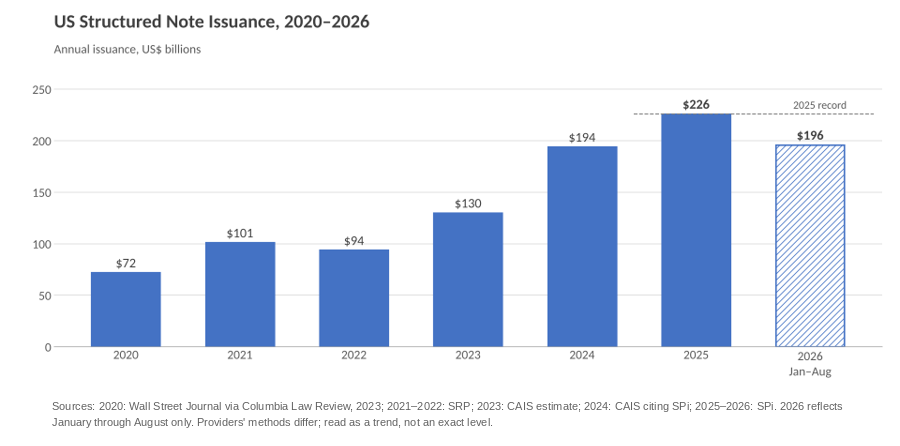
US structured note issuance roughly tripled from about $72 billion in 2020 to a record $226 billion in 2025. The growth held through near-zero rates, the 2022 selloff in both stocks and bonds, and the rally that followed. Issuance dipped only about 7% in 2022, then set new records in 2024 and 2025.
Through August 2026, issuance was running 38.8% ahead of the prior year. Those figures should be read as a trend rather than an exact level because market-size and issuance data come from different providers with different methods.
The persistence of demand suggests a structural preference for defined terms: a stated coupon, a known downside threshold, and a fixed maturity.
Defined outcome ETFs expanded the market rather than replacing notes
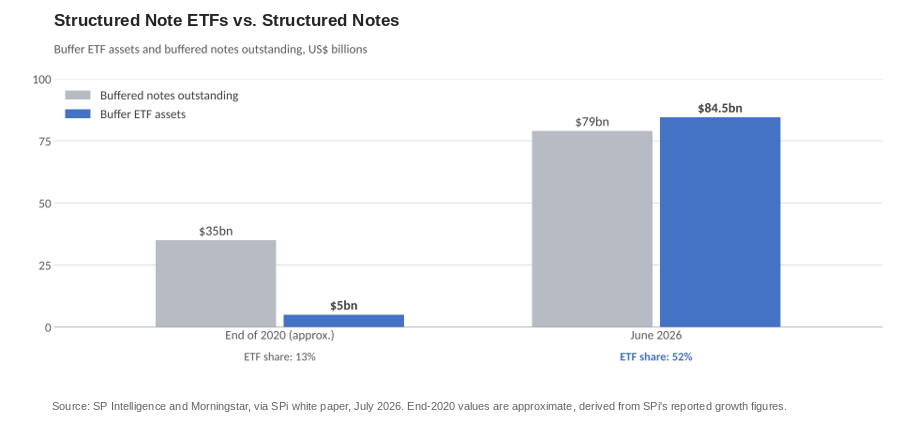
Defined outcome ETFs and buffered structured notes grew together. Buffer ETFs grew from roughly $5 billion at the end of 2020 to $84.5 billion by June 2026. Buffered notes outstanding more than doubled over the same period, from about $35 billion to $79 billion.
The two formats tend to serve different needs. ETFs offer daily liquidity and standardized outcome periods. Notes offer fixed maturities, coupons, deeper protection, and terms built around a specific objective.
The result is a wider defined-outcome market, not simply a rotation from one wrapper to another.
The market is global, and the US is still a newer growth center
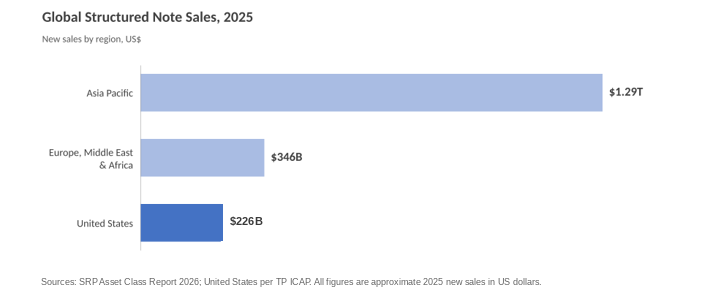
Structured notes are already a large global market. In 2025, estimated new sales were about $1.29 trillion in Asia Pacific, $346 billion in Europe, the Middle East, and Africa, and $225 billion in the United States.
The US was the smallest of those three regions in 2025, but much of its growth has come during this decade. That leaves room for continued expansion, while the risks remain material: issuer credit risk, limited liquidity, contingent payments, possible principal loss, capped upside, call risk, reinvestment risk, embedded costs, and dependence on the terms of each note.
Downloads
How Structured Notes Went Mainstream.pdf
Download PDFFrequently Asked Questions
Why did structured notes move beyond private banking?
Access improved. Standardized issuance, lower minimums, multi-issuer pricing, third-party valuation, and DTC settlement made structured notes easier to compare, value, and hold across different advisory and custodial channels.
Did structured note growth depend on one market environment?
No. US issuance grew through near-zero rates, the 2022 selloff in stocks and bonds, and the rally that followed. That pattern points to demand for defined outcomes rather than a single market call.
How are structured notes different from defined outcome ETFs?
Defined outcome ETFs generally offer daily liquidity and standardized outcome periods. Structured notes can offer fixed maturities, coupons, deeper protection, and terms built around a specific objective. Both carry risks, and stated outcomes depend on their terms.
What are the main risks of structured notes?
Structured notes are unsecured debt obligations of the issuing bank. Payments depend on the issuer’s ability to pay. Notes may have limited liquidity, contingent coupons, capped upside, call features, embedded costs, and principal loss if market levels breach specified thresholds.