
Defined outcomes address the problem of concentrated wealth
A large family office with an operating business already carries one major undefined risk: the value and cash flow of the business itself. A liquid portfolio built only from public equities, bonds and cash can unintentionally add a second version of the same economic risk.
In a hypothetical composite dated October 21, 2026, a $1 billion family with roughly $500 million of liquid capital reallocates $200 million from a traditional 60% equity, 30% bond and 10% cash mix into an actively managed structured note program. The objective is not to eliminate risk. It is to make a portion of the liquid portfolio’s risk more explicit: where income is earned, where downside is absorbed and where losses begin.
The case is illustrative only. No actual client, allocation, return or term is described.
Structured notes define the payoff before capital is committed
A structured note is an unsecured debt obligation of an issuing bank with a payoff tied to a reference asset, typically an equity index or basket of indices. The investor owns a senior note of the bank in a custodial account. The note’s terms specify the conditions for coupons, upside participation, principal repayment and losses.
That structure changes the conversation from open-ended exposure to negotiated exposure:
- Income notes can pay contingent coupons funded by equity volatility rather than by interest rates alone.
- Buffered growth notes can absorb a stated first layer of equity losses at maturity in exchange for giving up index dividends.
- Barriers can protect principal if the underlying remains above a specified level at maturity, but they are not the same as buffers. If a barrier is breached at maturity, losses may match the underlying one-for-one.
Nothing is free. Higher coupons, buffers, participation rates and barriers are all terms of exchange written into the note at issuance.
A program is different from a one-off note
The illustrative $200 million allocation is split into two actively managed sleeves:
The construction matters. One note is one entry point, one maturity, one issuer and one set of terms. A managed program spreads issuance over time, uses multiple investment-grade banks, caps issuer exposure and reinvests maturities on a schedule.
In this framework, 18 investment-grade global banks compete on the same terms. The winning bank issues the note at par. The adviser is compensated through a disclosed management fee on the sleeve rather than a retained concession on each note.

The outcome is more defined, not risk-free
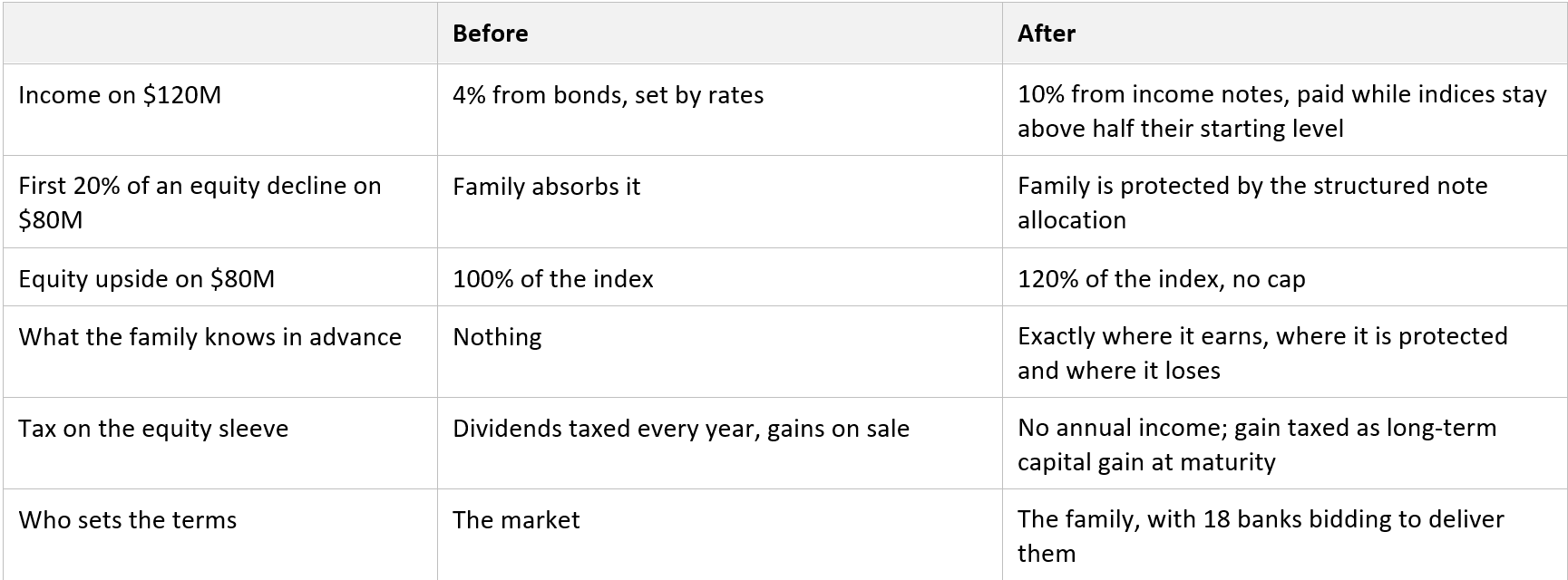
The hypothetical allocation replaces part of a liquid portfolio’s undefined stock-and-bond exposure with pre-agreed payoffs:
- On the $120 million income sleeve, the scenario compares roughly 4% bond income with approximately 10% contingent note income, paid only while index conditions are met.
- On the $80 million growth sleeve, the family gives up dividends but receives a 20% buffer against equity losses at maturity and 120% participation in index gains, with no cap in the representative terms.
- The remaining $300 million stays in a simpler mix of an index core, short bond ladder and cash reserve.
The risks remain material. Structured notes are unsecured bank debt, are not FDIC insured and depend on the issuer’s creditworthiness. Protection generally applies only at maturity. Interim values may be below par even when the maturity payoff appears favorable. Secondary liquidity can be limited. Notes may forgo dividends, may be called early and may include embedded hedging costs. Tax treatment varies by structure and investor circumstances; contingent coupons are generally ordinary income, while many growth notes are generally structured as prepaid forward contracts, but tax treatment should be confirmed with a qualified tax adviser.
Scenario figures assume hold to maturity and do not reflect advisory fees, transaction costs or taxes, all of which would reduce returns.
Downloads
Invictus - Bespoke Structured Note Portfolios.pdf
Download PDFFrequently Asked Questions
Is a structured note a fund, hedge fund or annuity?
No. A structured note is a single security issued by a bank. It sits in the investor’s custodial account like another bond, but its payoff is tied to terms such as an index level, coupon condition, buffer, barrier or participation rate.
What is the difference between a buffer and a barrier?
A buffer absorbs a stated first portion of losses. With a 20% buffer, the first 20% of a decline is covered, and losses begin beyond that level. A barrier protects principal only if the underlying remains above a specified level at maturity. If the barrier is breached at maturity, the investor may take the full underlying loss.
Can structured notes be sold before maturity?
Yes, but notes are generally designed to be held to maturity. The issuing bank may quote a daily bid, but the secondary market can be thin and the interim price may be below par even when the expected maturity payoff remains intact.
Where do the income and protection come from?
They come from the economics of the agreed terms. A contingent coupon compensates the investor for accepting defined downside conditions. A buffer is typically funded by giving up dividends or accepting other trade-offs. The note makes those exchanges explicit at issuance.
What are the main risks of a structured note program?
Key risks include issuer credit risk, loss of principal, limited liquidity, unfavorable interim pricing, missed contingent coupons, reinvestment risk if a note is called, dividend forfeiture, tax uncertainty and the possibility that a barrier breach leads to one-for-one losses with the underlying index or basket.